
Importance of Clear and Timely Communication in Customer Service

Start Your Free Trial

A customer may forgive a mistake, but they are far less likely to forgive being ignored, confused, or left without an update.
In customer service, the quality of communication often shapes the entire customer experience. Even when a problem cannot be resolved immediately, a clear and timely response can reassure the customer that their concern has been heard and is being handled. Timely communication means responding to questions, concerns, and issues within the timeframe customers reasonably expect for the channel and situation. It is not simply about replying quickly. It is about responding soon enough to prevent uncertainty, frustration, and loss of trust.
Timely service follows the same principle: customers receive the support, progress update, or next step they need before a delay begins to damage their experience. Clear communication complements speed by using plain language, avoiding unnecessary jargon, listening carefully, and confirming what will happen next. Together, clarity and responsiveness form the foundation of effective customer service communication. They help customers feel valued, reduce misunderstandings and repeated enquiries, and make interactions easier to resolve.
This article explains why clear and timely communication matters in customer service and how strengthening both can improve customer satisfaction, loyalty, and overall business performance.
Clear vs. Timely: Two Different But Related Skills
Clear and timely communication work together to create better customer experiences, but they solve different problems. Clear communication ensures customers understand the information, instructions, and next steps they receive, while timely communication ensures they get that information when they need it. Businesses that combine both can reduce confusion, improve satisfaction, and build stronger customer relationships.
| Skill | What it means | Customer outcome |
| Clear communication | The customer understands your answer, instructions, options, and next steps. | Fewer misunderstandings and better confidence. |
| Timely communication | The customer does not have to wait longer than expected for that channel or issue. | Less frustration and higher trust. |
Why Communication Matters in Customer Service
The importance of communication in customer service comes down to trust. Customers contact a business because they need information, reassurance, a solution, or a decision. When your team responds clearly and promptly, customers are more likely to stay engaged instead of calling a competitor.
Customer expectations are rising. Zendesk’s CX Trends 2026 report says 74% of consumers now expect customer service to be available 24/7, and 88% expect faster response times than they did a year earlier. That is why customer communication is no longer just a support-team issue. It affects sales, retention, reputation, and long-term growth.
What the Data Says About Response Speed and Customer Loyalty
- Customers expect fast and effective responses: Customers are more likely to stay loyal to businesses that respond quickly, clearly, and consistently. When communication feels slow, confusing, or unhelpful, customers may start looking for alternatives.
- Poor service experiences drive customers away:
- According to Zendesk’s 2026 customer service statistics report, more than 50% of consumers will switch to a competitor after a single bad experience.
- After multiple negative experiences, 73% of customers are likely to switch brands.
- PwC research also found that 55% of consumers would stop buying from a company after several bad experiences, while 32% would leave because of inconsistent customer experiences.
- Email support remains a major communication challenge: SuperOffice’s customer service benchmark study revealed that many companies struggle to provide timely and complete email support:
- 62% of companies failed to respond to customer service emails.
- 90% did not send an acknowledgment confirming receipt of the customer’s message.
- Only 20% provided a complete answer in their first response.
- The average response time among companies that replied was 12 hours and 10 minutes.
- Delayed communication can damage more than customer satisfaction: A slow response is not just a minor inconvenience. Without timely updates and clear information, delays can lead to:
- Loss of customer trust
- Lower customer retention
- Increased frustration and repeat enquiries
- Reduced revenue opportunities
- Businesses need clear communication standards: Setting response-time expectations, using consistent messaging, and ensuring customers always know the next step can turn customer service interactions into trust-building experiences.
Customer Communication Channels: Where Timing Expectations Differ
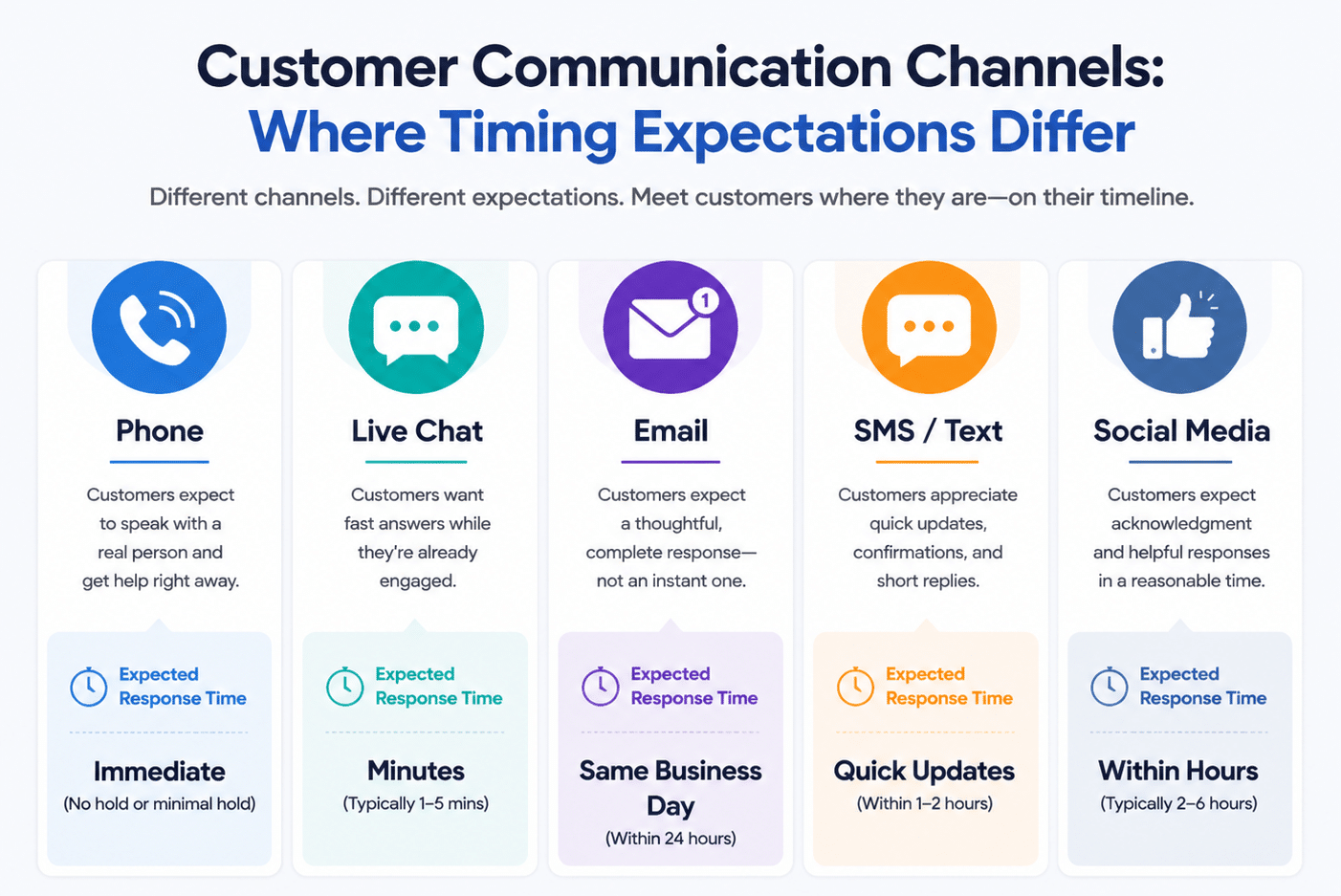
Different customer service channels come with different timing expectations, so businesses need channel-specific response standards.
- Phone support usually carries the highest urgency. Customers who call often want immediate human help, especially when they are trying to book, buy, reschedule, or resolve a stressful issue. A live answering or virtual receptionist service can help close this gap by making sure calls are answered professionally, including after hours.
- Live chat should feel near-instant. Email can allow a little more time, but customers still expect acknowledgment and a clear next step. A same-business-day target is a practical baseline for many small businesses. SMS or text communication should be brief, clear, and fast. Customers often use text for appointment confirmations, quick updates, reminders, and urgent follow-ups.
- Social media should be monitored within hours because public comments, reviews, and direct messages can quickly affect reputation.
For small businesses that cannot staff every channel around the clock, a live answering solution can help streamline customer communication by handling calls, capturing details, and forwarding urgent matters to the right person.
Benefits of Clear and Timely Communication
Customer service is all about helping your customers efficiently and effectively. Clear and timely communication ensures customers feel valued, heard, and understood. This not only helps in resolving issues faster but also builds strong, lasting relationships that can translate into brand loyalty and increased revenue.
Here’s why customer service communication is so crucial:
Improved Relationships with Customers
When your team communicates clearly, it creates a sense of transparency and trust. Customers are more likely to remain loyal to a brand they trust, which means they will return for repeat purchases and recommend your brand to others. Effective communication is a cornerstone of this trust, especially when it comes to resolving concerns and meeting customer needs.
Increased Customer Satisfaction
Customer satisfaction is closely tied to how well your company communicates. When customers receive timely and accurate information, they feel valued. This satisfaction leads to higher retention rates, more referrals, and positive reviews. In fact, word-of-mouth marketing generated by satisfied customers accounts for over $6 trillion in annual consumer spending.
More Efficient Problem Resolution
If your business responds quickly when a customer has an issue or complaint, it shows them you’re serious about resolving their problem as soon as possible. Clear communication also helps ensure that the customer understands the steps needed to solve the issue, so there’s less back-and-forth before it’s resolved.
This saves both parties time and money because you don’t have to spend extra resources on re-explaining things or running through multiple attempts at resolving the same issue.
Improved Reputation
Most customers value companies with good customer service over those without it. Having clear and timely communication is essential for building a positive reputation. Poor customer service can result in negative reviews and bad impressions, which can be very damaging to a company’s bottom line. However, when you ensure your customer service team is always available and easy to contact, you’ll build trust with your customers and create loyal relationships.
Higher Conversion Rates
When customers feel their questions are being addressed promptly, they’re more likely to move forward with a purchase. This is where having effective customer service communication systems in place, like a virtual receptionist—becomes invaluable. Whether it’s booking appointments, making reservations, or answering product queries, timely communication drives conversions.
Reduces Costs
Good communication leads to better customer experiences, which in turn lead to more sales. With clear communication, you reduce the chances of misunderstandings and ensure customers feel more confident in making a purchase. Happy customers are more likely to return for additional purchases and become repeat buyers.
Common Barriers to Timely, Clear Communication
Most communication problems are caused by process gaps, not bad intentions. Small businesses often fall behind because the same employees are answering calls, serving customers, managing operations, and handling admin work. When the team gets busy, customer replies slow down.
Common barriers include understaffed support teams, no after-hours coverage, inconsistent scripts across channels, unclear ownership of follow-ups, and no documented response-time standards.
Another barrier is fragmented communication. A customer might call, then email, then send a social message, but if those conversations are not tracked in one place, the customer may have to repeat the same information multiple times. That weakens the experience and makes the business look disorganized.
How to Improve Communication in Customer Service
Leverage Virtual Receptionists and Answering Services
Small businesses, in particular, may struggle with maintaining communication around the clock. One effective solution is to work with virtual receptionists. These professionals can handle customer inquiries, schedule appointments, and provide personalized service even when your business is closed.
A remote live answering service ensures that your business doesn’t miss any inquiries, providing prompt and professional responses to customers. This prevents lost opportunities and helps maintain excellent communication standards.
Train Your Customer Service Team
Training your team in effective communication is essential. Ensure they understand the importance of clear, timely, and empathetic communication in customer service. Provide scripts, role-playing exercises, and feedback loops to continuously improve their skills.
Utilize Technology to Streamline Communication
Implementing chatbots, automated response systems, and AI-powered customer service tools can help streamline communication processes. These tools provide instant responses to common customer questions and allow your team to focus on more complex issues.
Set Channel-Specific Response-Time Targets
A clear response-time standard helps your team understand what “timely” actually means. Set realistic targets for each channel. For example: answer phone calls live when possible, respond to live chat within minutes, acknowledge emails the same business day, and monitor urgent social messages within a few hours. The goal is not to promise impossible speed. The goal is to make timing predictable.
Use Templates That Still Sound Personal
Templates save time, but they should not sound robotic. Create approved responses for common questions about hours, pricing, scheduling, cancellations, service areas, intake requirements, and next steps. Then train your team to personalize them with the customer’s name, issue, and specific timeline. This helps streamline customer communication without sacrificing empathy.
Confirm Next Steps in Writing
Customers feel more confident when they can see what will happen next. After a phone call or live chat, send a short confirmation by email or text. Include the appointment time, documents needed, quoted timeline, ticket number, or person responsible for follow-up. This reduces confusion and improves correspondence with customers across the entire journey.
Track First Response Time as a KPI
You cannot improve communication speed unless you measure it. Track first response time, average resolution time, missed calls, abandoned chats, unanswered emails, and customer satisfaction after support interactions. These metrics show where customers are waiting too long and where the team may need more coverage.
Train for Clarity, Empathy, and Active Listening
Customer service teams need communication training, not just product knowledge. Train employees to listen before answering, repeat important details back to the customer, avoid jargon, and explain next steps in plain language. Role-playing difficult calls can help agents practice staying calm, helpful, and specific.
Work With Posh for Improved Customer Service Communication
Hiring Posh is a great way to ensure that your customer service is communicating with your clients clearly and promptly. Our virtual receptionists are always available. No matter what time it is, you can rest assured that there will always be someone who will attend to your clients’ needs.
Additionally, we take the time to get to know your business and personalize our communications accordingly. We create an overall experience that builds customer loyalty. With us, you can count on exceptional customer service communication every single time.
Contact Posh to try the service free for one week and see how clearer, faster communication can improve your customer experience.
FAQ:
1. How does poor communication affect customer relationships?
Poor communication can make customers feel undervalued, even when a business eventually solves their issue. Lack of updates, unclear explanations, or inconsistent responses can reduce confidence in the brand and increase the likelihood of customers seeking alternatives.
2. How can businesses measure the quality of their customer communication?
Businesses can evaluate communication quality through metrics such as customer satisfaction scores (CSAT), response and resolution times, repeat contact rates, customer feedback, and complaint trends. These insights help identify where communication processes need improvement.
3. What role does active listening play in customer service communication?
Active listening helps customer service teams understand the real concern behind a customer’s request. By acknowledging the issue, asking relevant questions, and confirming details, businesses can provide more accurate solutions and create a better customer experience.
4. How can businesses make customer communication more personal?
Businesses can personalize communication by using customer information appropriately, referring to previous interactions, acknowledging individual concerns, and avoiding generic responses. Personalized communication helps customers feel recognized rather than treated like a ticket number.
5. Why is consistency important in customer service communication?
Consistent communication ensures customers receive the same level of service across different channels and team members. When responses, policies, and expectations vary, customers may become confused and lose trust in the business.
Contact Posh
Request Info
If you have questions, we have the
answers (and we're happy to share).