
How to Choose a Virtual Receptionist Service: A Step-by-Step Buyer’s Checklist for Business Leaders

Start Your Free Trial

Table of Contents
Summary
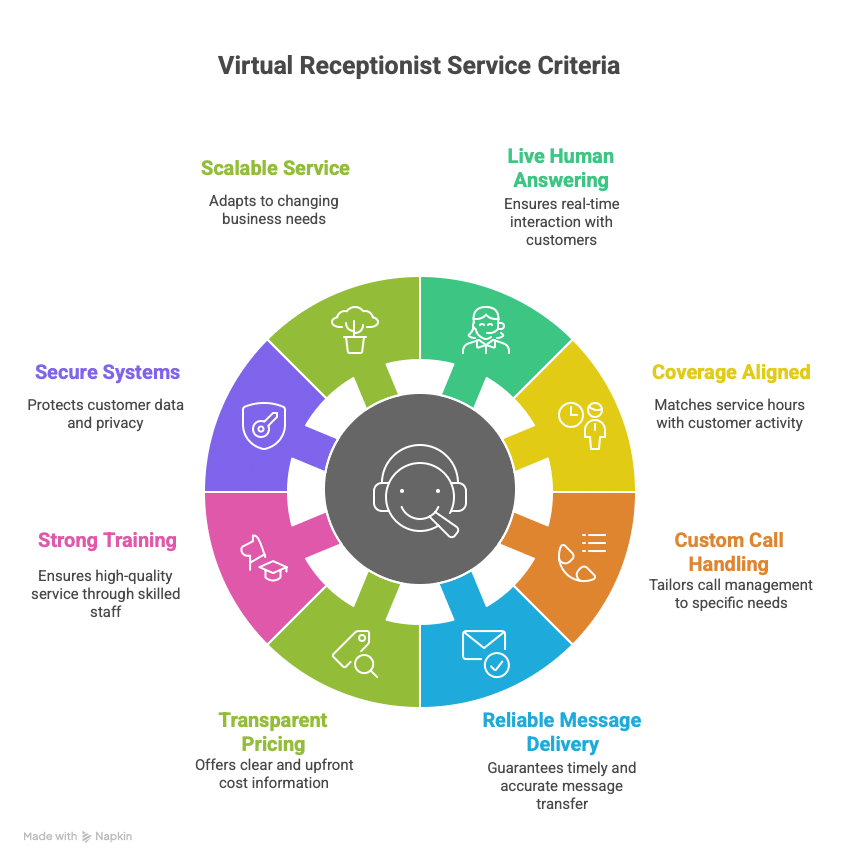
Selecting a virtual receptionist service is a strategic decision that directly affects customer experience, operational efficiency, and revenue protection. As businesses grow, internal teams often struggle to manage increasing call volumes without sacrificing responsiveness or productivity. This guide explains how to choose a virtual receptionist service using a structured, practical framework designed for business leaders. It outlines the essential evaluation criteria, including availability, live answering, customization, message accuracy, pricing transparency, security, and scalability. By following this step-by-step virtual receptionist buying guide, organizations can identify solutions that align with their operational needs and ensure every call is handled professionally and consistently.
Key Takeaway
A virtual receptionist is not simply a cost-saving measure but a critical component of a company’s front-line communication strategy. The best virtual receptionist service provides live, trained professionals, reliable coverage, and clear customization without adding operational complexity. Business leaders should prioritize service quality, transparency, and long-term scalability over price alone. A structured virtual receptionist service checklist helps avoid common selection mistakes and ensures alignment with customer expectations. When implemented correctly, a virtual receptionist improves call handling, protects brand reputation, and supports sustainable growth by ensuring no important call is missed—during business hours or beyond.
When customers, partners, or prospects call your business, are you certain every call is answered professionally, consistently, and without delay—regardless of time, volume, or staffing constraints?
For business owners, inbound calls are more than routine communication. They represent revenue opportunities, service requests, legal inquiries, patient concerns, and long-term customer relationships. Yet, despite their importance, phone calls are often one of the least optimized parts of business operations.
As companies scale, internal teams struggle to balance core responsibilities with call handling. Missed calls increase. Response times are slow. Staff productivity declines. Over time, these inefficiencies quietly erode customer trust and business performance.
This reality has led many organizations to explore the use of a Virtual receptionist.
This article is a guide on how to choose a virtual receptionist service. So, let’s dive in.
The Strategic Role of a Virtual Receptionist in Modern Businesses
A Virtual receptionist is a trained, live professional who answers incoming calls on behalf of your organization from a remote location. Unlike automated phone systems or call trees, a 24/7 virtual receptionist provides human interaction while following defined business protocols.
Core responsibilities typically include:
- Answering inbound calls using your business name
- Identifying caller’s needs
- Transferring calls based on predefined rules
- Taking detailed and accurate messages
- Scheduling or confirming appointments
- Providing general business information
From an operational perspective, a virtual receptionist functions as an extension of your front office without the fixed costs, management overhead, or space requirements associated with in-house staff.
For leadership teams, this creates a balance between service quality and operational efficiency.
Why Virtual Receptionist Services Have Become a Business Necessity
Customer expectations continue to rise. Callers expect immediate acknowledgment, clear communication, and a professional tone. When calls go unanswered or reach voicemail, many callers do not wait. They move on.
From a leadership standpoint, this creates measurable risk:
- Lost leads
- Lower customer satisfaction
- Reduced conversion rates
- Increased staff stress
Businesses seeking the best virtual receptionist service are often attempting to address one or more of the following challenges:
- Inconsistent call coverage
- Limited internal staffing
- Growth-related call volume increases
- After-hours customer inquiries
Understanding these pressures is essential before evaluating vendors or pricing. The goal is not simply to outsource calls, but to protect revenue and brand reputation.
Step 1: Define the Business Problem You Are Solving
Any effective virtual receptionist buying guide begins with internal clarity. Before comparing providers, leaders must identify the specific operational gaps they intend to address.
Key questions to consider:
- Are calls being missed during peak hours?
- Do staff members lose productivity answering phones?
- Are important calls coming in after business hours?
- Is call handling inconsistent across team members?
- Do callers require live assistance rather than voicemail?
A virtual receptionist should solve a defined problem. Without this clarity, businesses risk overpaying or selecting a service that does not align with operational needs.
Step 2: Assess Required Coverage and Availability
Availability is a central component of any virtual 24/7 receptionist service checklist.
Some businesses only need support during overflow periods. Others require consistent coverage outside standard hours. For many industries, after-hours calls are not optional; they are mission-critical.
An after hours answering service ensures that customer inquiries, service requests, or urgent calls are handled professionally, even when internal offices are closed. For businesses operating across multiple time zones or serving clients nationwide, a 24/7 virtual receptionist model provides continuity and reliability.
Coverage should reflect customer behavior, not internal convenience.
Step 3: Confirm Live Answering by Trained Professionals
Not all services marketed as virtual receptionists offer the same experience. Some rely on scripted responses or automated workflows that limit flexibility.
A high-quality virtual 24/7 receptionist service provides:
- Live, U.S.-based professionals
- Natural, conversational communication
- Situational judgment rather than rigid scripts
- Professional tone aligned with your brand
From a leadership perspective, this matters because the receptionist represents your organization. Callers form opinions quickly. A poor experience reflects directly on leadership and company values.
This distinction is critical when evaluating how to choose a virtual receptionist service.
Step 4: Customization and Operational Alignment
No two businesses operate the same way. A virtual receptionist service must be adaptable to your structure, policies, and customer expectations.
Customization options should include:
- Personalized call greetings
- Business-specific call routing instructions
- Escalation protocols for urgent matters
- Tailored message-taking procedures
Without customization, receptionists operate generically, leading to misrouted calls and frustrated callers.
In any serious virtual 24/7 receptionist guide, customization is not optional—it is foundational.
Step 5: Call Routing and Message Accuracy
Operational efficiency depends on accurate information flow.
A professional virtual receptionist service ensures:
- Messages include correct caller details
- Call intent is clearly summarized
- Messages are delivered promptly
- Staff can respond without clarification
Poor message handling leads to delays, repeat calls, and internal inefficiencies. This factor should be weighed carefully in your virtual 24/7 receptionist service checklist.
Step 6: Appointment Scheduling Capabilities
For many service-driven businesses, scheduling is a major function of inbound calls.
A virtual receptionist that supports scheduling can:
- Reduce administrative workload
- Improve customer response time
- Minimize scheduling errors
When evaluating scheduling capabilities, leaders should consider:
- Calendar system compatibility
- Real-time availability management
- Handling of cancellations and reschedules
Scheduling support should simplify operations, not introduce new risks.
Step 7: Pricing Transparency and Financial Predictability
From a financial leadership perspective, predictability matters.
When comparing providers, the best virtual receptionist service offers:
- Clear pricing tiers
- Defined usage limits
- Transparent overage policies
- Flexible scaling options
Avoid services with complex or unclear pricing structures. Cost clarity supports long-term planning and accountability.
Step 8: Training, Quality Assurance, and Performance Standards
Consistency is a leadership concern. Callers should receive the same level of professionalism regardless of timing or volume.
Strong virtual 24/7 receptionist services invest in:
- Structured training programs
- Ongoing performance evaluation
- Call monitoring and feedback
- Documented service standards
This ensures that the receptionist experience aligns with your organization’s expectations at all times.
Step 9: Security, Confidentiality, and Trust
Inbound calls often involve sensitive information.
Business leaders should confirm that their virtual receptionist service follows secure data handling practices and respects confidentiality. This is particularly important for industries dealing with personal, financial, or regulated information.
Trust is a non-negotiable element of outsourced communication.
Step 10: Scalability and Long-Term Partnership
Businesses evolve. A service that fits today may not fit tomorrow.
The best virtual receptionist supports:
- Increased call volumes
- Business expansion
- Additional service requirements
- Longer coverage hours
Scalability ensures that your investment continues to deliver value as your organization grows.
Common Errors Leaders Make When Selecting a Service
Even experienced executives can overlook key details.
Common mistakes include:
- Selecting based solely on cost
- Ignoring call quality and training
- Overlooking customization
- Failing to plan for growth
Using a structured virtual receptionist service checklist helps mitigate these risks.
How Posh Structures Virtual Receptionist Services
Some providers emphasize scale. Others emphasize experience.
Posh focuses on delivering professional, human-centered call handling designed to align with each client’s operational needs.
Posh services include:
- Live, U.S.-based receptionists
- Custom call handling protocols
- Accurate message delivery
- Support for after-hours and continuous coverage
Organizations seeking dependable availability often consider a 24/7 virtual receptionist model to ensure no call is missed.
This approach is designed to support businesses that value professionalism, reliability, and customer trust.
Why the Right Decision Matters at the Leadership Level
Every inbound call represents a decision point for the caller. The experience they receive influences whether they engage further or disengage entirely.
A virtual 24/7 receptionist plays a direct role in:
- Customer perception
- Lead conversion
- Brand reputation
- Operational efficiency
For leadership teams, choosing the right service is not a tactical decision—it is a strategic one.
Closing
A Virtual receptionist is not simply a cost-saving tool. It is a visible extension of your organization’s professionalism and operational discipline.
For leaders evaluating long-term solutions, we welcome you to contact us to discuss your needs in more detail. Our team will review your requirements carefully and respond promptly to explore how the right virtual 24/7 receptionist approach can support your business objectives.
When every call has the potential to influence revenue, reputation, and relationships, is it reasonable to leave that experience unmanaged?
Frequently Asked Questions
1. What is the difference between a virtual receptionist and a call center?
A virtual receptionist provides personalized, live call handling tailored to your business, including greeting callers by your company name, message taking, and appointment scheduling. In contrast, a call center typically handles high call volumes with generic scripts and may focus on tasks such as customer support, telemarketing, or technical assistance. Virtual receptionists act as an extension of your brand, while call centers prioritize efficiency and scale.
2. How quickly can I set up a virtual receptionist service for my business?
Most virtual receptionist services can be set up within a few days. After selecting a provider, you’ll typically have an onboarding call to discuss your call handling preferences, scripts, and integration needs. Some services offer same-day setup, while others may take a few business days to fully customize your account and train their team on your protocols.
3. Can a virtual receptionist handle multiple languages?
Yes, many virtual receptionist services offer bilingual or multilingual support. This is particularly valuable for businesses serving diverse communities or international clients. When evaluating providers, ask about language capabilities and whether they have dedicated agents fluent in the languages your customers speak.
4. What types of businesses benefit most from virtual receptionist services?
Virtual receptionist services are beneficial for a wide range of businesses, including law firms, healthcare practices, real estate agencies, home services, consultancies, and any organization that relies on inbound calls for sales, support, or scheduling. They are especially valuable for small to mid-sized businesses that want professional call coverage without hiring in-house staff.
5. How does a virtual receptionist integrate with my existing systems (like calendars or CRMs)?
Most modern virtual receptionist services offer integrations with popular calendar platforms (Google Calendar, Outlook, etc.) and customer relationship management (CRM) systems. This allows for seamless appointment scheduling, message logging, and contact updates. Ask your provider about integration options and any setup required to connect with your current tools.
6. Is my business information and caller data secure with a virtual receptionist service?
Reputable virtual receptionist providers implement strict data security protocols, including encryption, secure data storage, and regular staff training on confidentiality. For industries with regulatory requirements (such as healthcare or legal), look for services that offer HIPAA or other compliance certifications. Always review a provider’s privacy policy and security measures before signing up.
7. Can I customize how my virtual receptionist answers and routes calls?
Absolutely. One of the primary benefits of a virtual receptionist is customization. You can specify greeting scripts, call routing rules, escalation procedures for urgent matters, and even detailed instructions for different call scenarios. Regular reviews and updates to your protocols ensure the service always reflects your current business needs and brand voice.
Related Articles





Contact Posh
Request Info
If you have questions, we have the
answers (and we're happy to share).